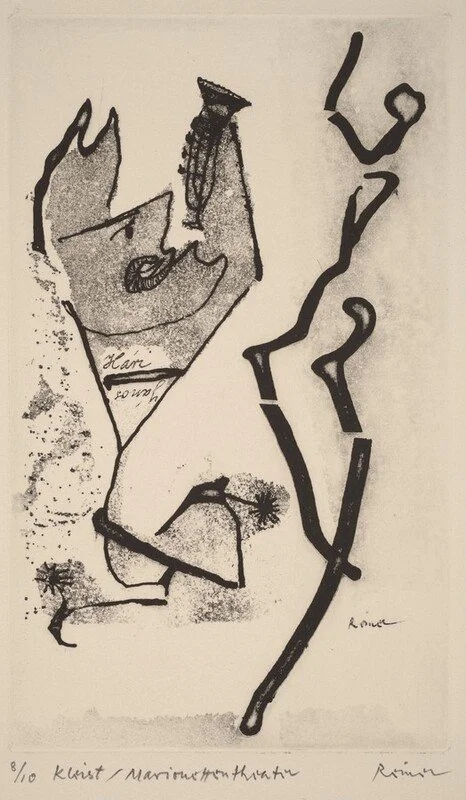
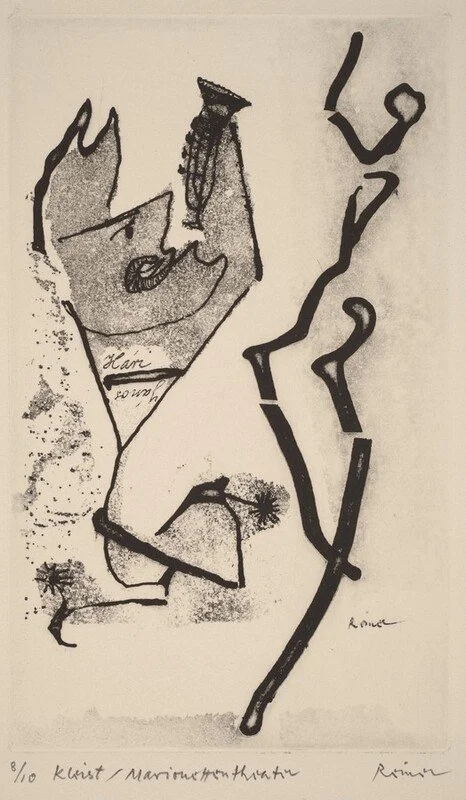
Imre Reiner (1900–1987), Von Kleist/Marionettentheater, 1964
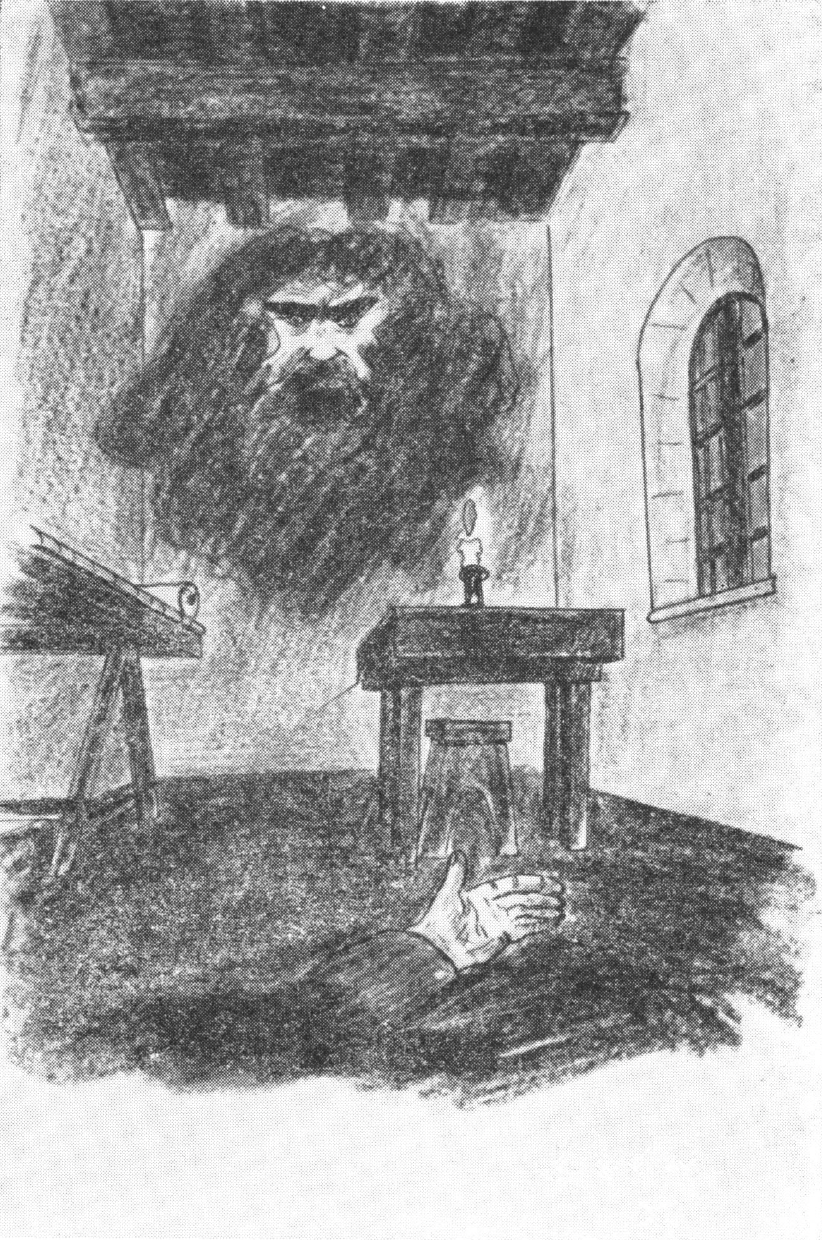
“The Splitting of the Image of the Body”. Drawing created by one of Pankow’s patients during the therapeutic process. (Gisela Pankow, Du corps perdu au corps retrouvé : une introduction à la psychothérapie analytique des psychoses, Tijdschrift Voor Filosofie, (2):223, Peeters, 1968)
In this talk, I analyze the philosophical effects of Kleist’s literary gesture in his 1810 essay, On the Marionette Theatre. The essay has often been read as a condensed expression of the spontaneous philosophy that runs through Kleist’s entire body of work. This philosophy may be characterized as an ontology of splitting or division. Profoundly unsettled by the advent of critical philosophy and by the many limits and dualisms it established between the noumenal and the phenomenal, Kleist shows little concern for the mediations through which Kant, Fichte and the post-Kantians sought to synthesize these oppositions. Instead, Kleist absolutizes the split between consciousness and reality as it is in itself, granting it the status of an ontological law.
The Marionettentheater stages the split through three main figures: the marionette, the human being, and the god. The human is situated between, on the one hand, an artificial body, devoid of consciousness yet perfectly adequate to its movement, and, on the other, an infinite, divine consciousness, free from all reflexivity and all corporeality. Only the puppet and the god are “graceful,” for grace stands at the farthest remove from finite consciousness. It is denied to humanity, whose very burden is consciousness or reflection. Far from offering any dialectical reconciliation, Kleist presents us with no alternative at all: “either no consciousness at all, or else an infinite consciousness.” I argue that it is in relation to J. G. Fichte’s philosophy that the full radicality of Kleist’s position comes into view. By demonstrating that an absolute split must (muss) remain impossible if finite consciousness is to be (soll) possible at all, Fichtean transcendentalism allows us to bring out the problematic character of Kleist’s a-dialectical position. Fichte’s conception of the creative imagination will serve as the guiding thread of this reading. As the activity that composes opposites—finite and infinite, I and not-I, unity and multiplicity—imagination designates the power of surviving the split, and of inhabiting it in and through the body. More specifically, I draw on the relation between imagination and corporeality in Fichte’s Jena writings (1793–1799) in order to make my way through Kleist’s allegorical essay. By attending closely to its scenes and figures, I show that, in Fichte, the transcendental body appears both as the primordial condition of intersubjective relation and as the site where nature and freedom interpenetrate. Kleist’s theater, by contrast, presents a range of anatomies and morphologies that mark out various ways of inhabiting the world through the body, or of becoming estranged from it. On this basis, my reading concludes by turning to Gisela Pankow’s psychoanalytic work on the image of the body in psychosis. I then inquire, beyond Kleist’s real or apparent pessimism, into the “therapeutic” potentialities of his text—and of the Fichtean demand for unity that this text refuses.
Habib Bardi is a writer and musician living and working in Montréal, Québec. His research centers on the foundational problems of late eighteenth- and early nineteenth-century German philosophy, with a particular focus on the problems of image and imagination in transcendental philosophy. He is currently completing an MA thesis, Figures de l'imagination transcendantale : Kant, Maimon, Fichte (1781–1799), under the supervision of Augustin Dumont at Université de Montréal. As a musician and improvisor, he is involved in several ensembles as an alto saxophonist and makes electroacoustic compositions and film scores. Alongside his musical and academic work, he practices as a community therapist at La Chrysalide Therapeutic Community in Montréal.